

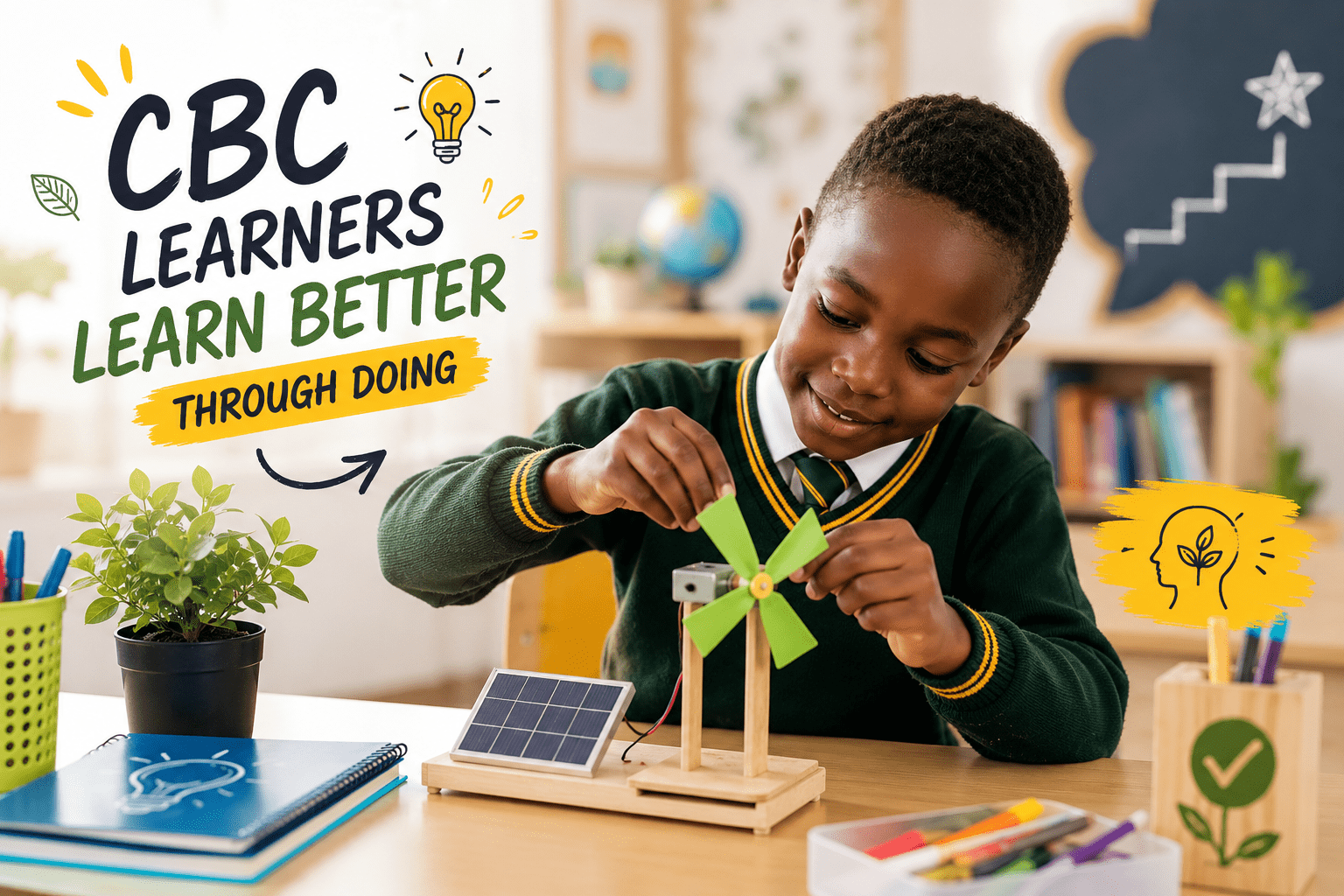
In Kenya’s Competency-Based Curriculum (CBC), learning is no longer just about opening a book, reading notes, and memorizing answers. Instead, it is about doing, experiencing, and applying knowledge in real life. This shift has changed how children understand lessons and why many CBC learners now perform better when they are actively involved in tasks rather than only reading theory.
Under the CBC system, a child is not just expected to know what something is, but also to understand how it works and where it is used. For example, instead of only reading about plants in a textbook, a learner may be asked to plant seeds, observe growth, and record changes. This simple activity turns a lesson into an experience. The child does not just remember facts—they understand life.
One of the biggest strengths of “learning by doing” is better memory retention. When a learner participates in an activity, the brain engages multiple senses at once. They see, touch, move, and sometimes even discuss what they are doing. This combination makes learning stick longer compared to reading alone. A child who builds a simple model in science is more likely to remember the concept than one who only reads about it.
CBC also builds confidence and independence. When learners complete tasks on their own—whether it is drawing, measuring, cutting, or building—they begin to trust their abilities. They are not waiting to be told everything by a teacher. Instead, they try, fail, correct mistakes, and improve. This process develops problem-solving skills that are useful beyond the classroom.
Another important benefit is creativity development. Doing activities allows children to explore different ways of solving a problem. There is no single fixed answer like in traditional memorization. A drawing task, a craft project, or a group activity allows learners to think differently and express themselves freely. This is why CBC encourages art, projects, and group work as part of daily learning.
CBC learning also connects education to real life situations. For instance, mathematics is not only about numbers in a book but can be applied when measuring ingredients in cooking or calculating distances. Science becomes meaningful when learners mix materials, observe reactions, and understand outcomes. This practical connection makes education feel relevant and interesting.
However, this method requires proper support. Learners need materials like stationery, workbooks, art supplies, and simple tools to complete their tasks. Parents and teachers also play a key role in guiding without doing the work for them. The goal is not perfection but participation and learning through experience.
In conclusion, CBC learners learn better through “doing” because it builds understanding, confidence, creativity, and real-life skills. Reading remains important, but it is only the starting point. True learning happens when knowledge moves from the page into action. That is the power of CBC—it turns learners into active thinkers, not passive readers.